
Ebook Free Algorithms to Live By: The Computer Science of Human Decisions
Make this book as favourite book to check out currently. There is no better book with the exact same subject as this. You can see exactly how the words that are created are really suitable to urge your condition making far better. Now, you could also really feel that the things of Algorithms To Live By: The Computer Science Of Human Decisions are proffered not only for making great opportunities for the viewers but additionally offer great ambience for the result of exactly what to write.
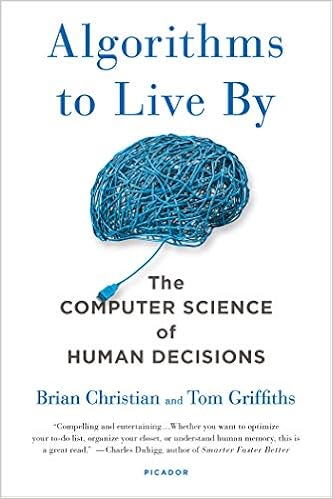
Algorithms to Live By: The Computer Science of Human Decisions

Ebook Free Algorithms to Live By: The Computer Science of Human Decisions
Exactly what do you do to begin reading Algorithms To Live By: The Computer Science Of Human Decisions Searching guide that you enjoy to read initial or discover an intriguing publication Algorithms To Live By: The Computer Science Of Human Decisions that will make you would like to review? Everyone has distinction with their factor of reading a book Algorithms To Live By: The Computer Science Of Human Decisions Actuary, reading practice has to be from earlier. Lots of people might be love to read, but not an e-book. It's not mistake. A person will certainly be bored to open the thick e-book with small words to check out. In even more, this is the genuine condition. So do take place most likely with this Algorithms To Live By: The Computer Science Of Human Decisions
Any publications that you check out, no matter just how you obtained the sentences that have read from guides, undoubtedly they will offer you goodness. However, we will certainly reveal you among suggestion of guide that you need to review. This Algorithms To Live By: The Computer Science Of Human Decisions is what we certainly suggest. We will certainly reveal you the practical reasons why you need to read this book. This publication is a kind of priceless publication created by a seasoned author.
In order to give the excellent resources as well as very easy means to provide the news and information, it involves you by obtaining the considerations that use thoughtful book ideas. When the motivations are coming gradually to require, you can quickly get the Algorithms To Live By: The Computer Science Of Human Decisions as resources. Why? Since, you can get them from the soft documents of the book that s confirmed in the web link supplied.
Just attach your gadget computer or gadget to the web attaching. Obtain the modern innovation making your downloading Algorithms To Live By: The Computer Science Of Human Decisions finished. Even you don't wish to check out, you can straight close guide soft file and open Algorithms To Live By: The Computer Science Of Human Decisions it later on. You could likewise easily get the book all over, because Algorithms To Live By: The Computer Science Of Human Decisions it remains in your gadget. Or when remaining in the workplace, this Algorithms To Live By: The Computer Science Of Human Decisions is additionally advised to read in your computer device.
Review
“A remarkable book... A solid, research-based book that’s applicable to real life. The algorithms the authors discuss are, in fact, more applicable to real-life problems than I’d have ever predicted.... It’s well worth the time to find a copy of Algorithms to Live By and dig deeper.â€â€•Forbes“By the end of the book, I was convinced. Not because I endorse the idea of living like some hyper-rational Vulcan, but because computing algorithms could be a surprisingly useful way to embrace the messy compromises of real, non-Vulcan life.â€â€•The Guardian (UK)“I absolutely reveled in this book... It's the perfect antidote to the argument you often hear from young math students: ‘What's the point? I'll never use this in real life!’... The whole business, whether it's the relative simplicity of the 37% rule or the mind-twisting possibilities of game theory, is both potentially practical and highly enjoyable as presented here. Recommended.â€â€•Popular Science (UK)“An entertaining, intelligently presented book... Craftily programmed to build from one good idea to the next... The value of being aware of algorithmic thinking―of the thornier details of ‘human algorithm design,’ as Christian and Griffiths put it―is not just better problem solving, but also greater insight into the human mind. And who doesn’t want to know how we tick?â€â€•Kirkus Reviews“Compelling and entertaining, Algorithms to Live By is packed with practical advice about how to use time, space, and effort more efficiently. And it’s a fascinating exploration of the workings of computer science and the human mind. Whether you want to optimize your to-do list, organize your closet, or understand human memory, this is a great read.â€â€•Charles Duhigg, author of The Power of Habit“In this remarkably lucid, fascinating, and compulsively readable book, Christian and Griffiths show how much we can learn from computers. We’ve all heard about the power of algorithms―but Algorithms to Live Byactually explains, brilliantly, how they work, and how we can take advantage of them to make better decisions in our own lives.â€â€•Alison Gopnik, coauthor of The Scientist in the Crib“I’ve been waiting for a book to come along that merges computational models with human psychology―and Christian and Griffiths have succeeded beyond all expectations. This is a wonderful book, written so that anyone can understand the computer science that runs our world―and more importantly, what it means to our lives.â€â€•David Eagleman, author of Incognito: The Secret Lives of the Brain
Read more
About the Author
Brian Christian is the author of The Most Human Human, a Wall Street Journal bestseller, New York Times editors’ choice, and a New Yorker favorite book of the year. His writing has appeared in The New Yorker, The Atlantic, Wired, The Wall Street Journal, The Guardian, and The Paris Review, as well as in scientific journals such as Cognitive Science, and has been translated into eleven languages. He lives in San Francisco.Tom Griffiths is a professor of psychology and cognitive science at UC Berkeley, where he directs the Computational Cognitive Science Lab. He has published more than 150 scientific papers on topics ranging from cognitive psychology to cultural evolution, and has received awards from the National Science Foundation, the Sloan Foundation, the American Psychological Association, and the Psychonomic Society, among others. He lives in Berkeley.
Read more
Product details
Paperback: 368 pages
Publisher: Picador; Reprint edition (April 4, 2017)
Language: English
ISBN-10: 1250118360
ISBN-13: 978-1250118363
Product Dimensions:
6.2 x 1 x 9.3 inches
Shipping Weight: 13.6 ounces (View shipping rates and policies)
Average Customer Review:
4.5 out of 5 stars
289 customer reviews
Amazon Best Sellers Rank:
#4,836 in Books (See Top 100 in Books)
[The original title of this review was: "Great book, though a few inaccuracies & bold claims". See below for two updates on the review and why I changed the title.]I'm a little over halfway with this recently published book, which I'm really enjoying so far - and I expect to enjoy it all the way to the end. A lot of great and unexpected insights here, and it seems that the authors did a good job explaining extremely complex algorithms and showing their applicability to real life (though it's hard for me to tell how good their explanations are to a novice, since I'm an expert in the field - I have two masters in Computer Science and working on my PhD, and was familiar with 90% of the algorithms described before opening the book).My biggest quibble with this book (and the reason they lost a star) is that I noticed a few annoying/sloppy inaccuracies, which makes [made! - see below for updates] me ever so slightly doubt the accuracy and veracity of other areas of the book that I'm less familiar with. The other issue is the boldness of their (otherwise very interesting) conjectures.For example, the authors misunderstand and misquote the 2-minute rule from David Allen's Getting Things Done, claiming the rule tells you to perform any less than 2-min task immediately when it occurs to you - and essentially simplifying the entire GTD system into the 2-min rule, which is in fact a tiny part of GTD (pg. 105-106). In fact, however, Allen does not suggest that at all - that would distract you from whatever you're currently engaged with, i.e. require a context switch (the costs of which the authors discuss at length). Instead, you should write that task down and add it to your intray, just like any other task. The 2-minute rule is applied later, while clearing your intray (which can be anytime in the next 48 hours). The point of the 2-minute rule is that the time spent on adding this task into your otherwise-extremely-flexible GTD system, and then tracking it in said system, would take longer than two minutes. This type of tracking is akin to what the authors refer to as "meta-work", and thus performing the 2-min task at inbox clearing time saves you an equal or greater amount of meta-work later. This is completely in line with the type of scheduling suggestions that the authors discuss. I'm not familiar with the other popular advice books the authors quote in the scheduling chapter or in the others chapters (e.g. the empty-your-closet type books they discuss in chapter 4), so I don't know if there are other such mischaracterizations, but it makes me suspect there might be. And I get that they're trying to differentiate their own advice from "all the other pop books out there", but if they're going to explicitly cite other books, they should try not to misrepresent them.Also, when discussing the Gittins rule and the multi-armed bandit problem, they say that a machine with a 0-0 record has "a Gittins index of 0.7029. In other words, something you have no experience with whatsoever is more attractive than a machine that you know pays out seven times out of ten!" (pg. 40). However, their own table on the same page clearly shows that a machine with a 7-3 record has a Gittins index of 0.7187, making such a machine ever so slightly superior to a 0-0 one. After some more reading I realized that what they meant was that a machine with a 0-0 record and *uncertainty* is better than a *certain payout* of 70% (i.e. guaranteed to payout 7 out of 10), but that was not what the text implied.To be clear, these inaccuracies in and of themselves aren't huge - but they planted a seed of doubt in my mind [which is not as big anymore - see below] as to whether there were other such misrepresentations or inaccuracies in the book that I simply hadn't caught, and detracted from my enjoyment of the book.The other concern I have with this book is that several chapters end with provocative suggestions that aren't actually empirically-backed. These conjectures are cool, but I'd have liked to see scientists be more careful about making such bold claims, or at least couching them in the need for more research to establish whether they were entirely true. One example here was the discussion about the decline of aging supposedly being a result of simply having a larger history to remember (pgs 103-104). This is a fascinating conjecture, and one that deserves to be studied properly, but they are basing it on some research work that was not age-related. I suspect the authors may be on to something, at least in the context of "normal aging" cognitive decline as opposed to, say, alzheimer-related decline. However, as stated in the text, the conjectures are stated a bit too strongly for my tastes ("But as you age, and begin to experience these sporadic latencies, take heart: the length of the delay is partly an indicator of the extent of your experience.", pg 104). I'd hate to see anyone making decisions based on them - potentially missing an earlier diagnosis, say, of alzheimer's, because the authors claimed that cognitive decline is totally normal.Quibbles and concerns notwithstanding, I'm definitely enjoying the book and I think it's a great addition to the new genre of what's being called by some "science-help". It's also a good read for people who are tired of the same-old, and thirsty for some advice that's off the beaten path.UPDATE:The rest of the book was as good as I expected.Additionally, I sent this review to the lead author (Brian Christian) in case he wanted to address these issues. I was delighted to receive a very thoughtful response from him! They will be fixing the Gittens rule description in the paperback edition, to make it clearer to the reader. The author respectfully disagreed with me on the other two issues (GTD 2 minute rule & cognitive decline).Given what I saw in the email, I'd say the intentions behind the book definitely merit 5 stars (even though I still disagree on their presentation of those two topics). However, I'll leave the original title & rating of 4 stars as it stands for the original hardcover edition, and for consistency's sake. As I originally said, the book stands as an excellent addition to the genre, and also likely as a great first exposure into Computer Science if you've never had any.2nd update:Apparently, this review is now listed as the top most helpful review on Amazon (cool!). The book has been so successful that the first author (Brian Christian) recently informed me that the book is now on its third printing, which means that the Gittins index issue mentioned above is now fixed in the current and future editions. As for the other issues I had, they are more subjective in nature, and not large enough in and of themselves to merit the original (harsher) title of the review. Again, for completeness' sake and to avoid rewriting history, I leave the original review as its stands and the original title is listed below the new title, with only a few comments in brackets leading readers to these updates in the bottom.
Algorithms to Live By: The Computer Science of Human Decisions by Brian Christian and Tom GriffithsThere are predictably a number of readers who will look at this title and shy away, thinking that a book with "algorithms" in its title must be just for techies and computer scientists. There will be others who pride themselves on being technologically astute who think they know all about algorithms already. Both groups are wrong. Both will be astounded and profoundly affected by the human applications Brian Christian and Tom Griffiths make in this book for all of us. I should qualify that; it is a book for anyone who has ever had difficulty in such tasks as "when to stop looking" (for an apartment, for instance); how to schedule a busy family's priorities; how to clean out the garage; how to stop thinking about a problem; how to network. In fact, all the day-to-day problems that follow us from waking up to going to bed are addressed here by the human use of algorithms. I confess that I was grateful for the definition of "algorithms" early in the book; it is one of those words that everyone uses but many of us would have been hard put to explain. Notice I wrote "would have been" because this book explains it all so clearly that neophytes can understand it and technological people will not feel they are being patronized. And all of us who really use this book (not just read, but use) will find it has made our lives more productive, better organized, and essentially, much happier. Brian Christian and Tom Griffiths are geniuses at combining cutting edge philosophy with information we can use to make our lives richer.
The most thoughtful and meaningful book I have read since Daniel Kahneman’s “Thinking Fast and Slowâ€. It extends that work by detailing the extensive computer science research that has been done which illuminates those techniques (i.e., algorithms) that support our brain’s natural capabilities in order to make the best possible life decisions. It shows when it pays to be precise and rigorous and when the best choices can be made by less stringent analyses. And where “winging it†or ‘using gut feelings’ may indeed produce the best results. The authors accomplish these valuable lessons through clear explanatory writing, pertinent examples drawn from both computer design and the real (human) world and a fine sense of humor.In addition to wonderfully fulfilling its stated goal the book also provides the reader with a solid overview of the current state of computer design and architecture and some strong validations of the received wisdom that has come to us from philosophy and religion.
This book is a very good introduction to several mathematical concepts that many people have heard of, but don't know much about. Brian Christian also does something very clever: he makes these concepts eminently relatable.It may sound like hyperbole, but the chapters on optimal stopping and explore/exploit changed my life. I save a lot more time not trying to figure out which parking spot to choose or where to eat.The most impactful concepts are clustered in the front of the book, which is again optimal for those readers with short attention spans. The stuff later in the book is also very enlightening, just not as universally applicable as optimal stopping or explore/exploit.This is not a book designed for people with an advanced understanding of math or computer science. It's designed as a gateway to bring in people like me who are interested in these fields, but are perhaps a little intimidated.Read it now, people.
Algorithms to Live By: The Computer Science of Human Decisions PDF
Algorithms to Live By: The Computer Science of Human Decisions EPub
Algorithms to Live By: The Computer Science of Human Decisions Doc
Algorithms to Live By: The Computer Science of Human Decisions iBooks
Algorithms to Live By: The Computer Science of Human Decisions rtf
Algorithms to Live By: The Computer Science of Human Decisions Mobipocket
Algorithms to Live By: The Computer Science of Human Decisions Kindle


Tidak ada komentar:
Write komentar